How-to guide
How to bowl spin: off spin and leg spin
Spin bowling starts with the grip and the fingers or wrist that turn the ball, but it lives or dies on flight, pace and length. Learn one stock ball, land it on the same spot, and use your net sessions to see how much it really turns.
How do you bowl spin?
Grip the ball so your fingers or wrist can turn it, give it a firm flick as you let go, and land it on a good length. Off spinners turn the ball mainly with the fingers. Leg spinners turn it mainly with the wrist. Both need flight, control and practice.
This guide covers the two main ways to spin the ball as a right-arm bowler: the off break, which turns from off to leg for a right-handed batter, and the leg break, which turns from leg to off. Left-arm spinners use the same ideas, mirrored. These are starting points for the nets, not a rebuild of your action. If you're a junior bowler, learn your grip and action with your coach.
How do you grip an off break?
Spread your first two fingers wide across the seam, with the top joint of each on it. Rest the ball against your third finger and keep your thumb light or off the ball. Most of the work comes from the index finger, so give it a good hold.
- Fingers apart. A wide gap between the first and second fingers gives you more leverage to turn the ball.
- Seam across the fingers. Hold the ball so the seam runs across your fingers, not along them, so they have something to grip.
- Relaxed hand. Squeezing the ball tightly makes it hard to spin. Hold it firmly enough to control it and no tighter.
How do you release an off break?
Turn the ball with your index finger as it leaves your hand, as if turning a door handle clockwise. Your wrist stays fairly firm and your palm finishes facing the leg side. Aim to have the seam spinning upright, not wobbling, so it grips when it lands.
Your body helps the fingers. Get side-on in your delivery stride, pull your front arm through and let your bowling arm come over nice and high. Rotate your hips and shoulders and follow through across your body. A spinner who stops at the crease and spins it with the hand alone loses turn and drift, and tires the fingers quickly.
- Finish your action. Your bowling hand should end up near your opposite hip after the ball has gone.
- Watch the seam. Ask a mate behind the net, or watch your clips, to see if the seam is spinning upright or wobbling sideways.
How do you grip a leg break?
Put your first two fingers on top of the ball, across the seam, and bend your third finger so its top joint sits along the seam. Your thumb rests lightly on the ball. The third finger does most of the spinning, so it needs a good feel of the seam.
- Third finger on the seam. This is the finger that rips the ball, so it needs the seam under it.
- Fingers on top. The ball sits in your fingers, not deep in your palm, so your wrist can move freely.
- Loose wrist. A cocked, relaxed wrist is what lets you spin the ball hard.
How do you release a leg break?
Let your wrist uncock and your third finger flick the ball out of the front of your hand, so it spins from leg to off. Your palm finishes facing the batter. Spin it hard; more revolutions mean more drift, dip and turn off the pitch.
The action is a little more front-on than an off spinner's. Turn your shoulders through hard, let your bowling arm come over and keep your eyes on your target all the way. Leg spin is harder to control than off spin, so expect a few loose balls while you learn. Give the spin priority first and the accuracy will come with practice.
When should you learn the googly?
Once your leg break lands where you want it, most of the time. The googly turns the other way, from off to leg, by turning your wrist over so the back of your hand faces the batter. It is only a weapon if it looks like your stock ball.
Learning variations too early can take the edge off your leg break, so keep the googly to short sets at the end of a session to begin with. Your stock ball is still the one that takes most of your overs.
How do you flight the ball?
Release the ball slightly upwards rather than flat, so it rises a little out of your hand and drops on to the pitch. A ball with plenty of spin on it dips late, which tempts the batter forward and makes the length harder to judge.
Flight is not slowness. A ball that is spun hard and given a little air will dip more than one that is simply lobbed up. Try a short set where you aim a touch higher at release and land it in the same place, then compare where those balls bounced with the flatter ones.
How fast should a spinner bowl?
At a pace you can spin hard and control. Too slow and the batter has time to get down the pitch or wait for it. Too quick and the ball skids on without turning. Find your stock pace, then learn to vary it a little without changing your action.
Spinners get their bowling speed like anyone else. Knowing your typical pace through the air makes it easier to bowl a slightly quicker or slower ball on purpose, and to see whether a change in pace also changed how much it turned.
How do you land it on a length?
Pick one spot on a good length and aim at it every ball. A spinner's good length is fuller than a seamer's, far enough up that the batter has to decide whether to come forward. Hitting that spot over after over matters more than big turn.
- Put a target down. A cone or a marker on a good length gives you something to hit and a way to check how you did.
- Fix your eyes on it. Look at the spot from the start of your run-up to the moment you let go.
- Short run-up, same every ball. A few steps you can repeat helps your length more than a longer approach.
How should spinners practise in the nets?
In short sets with one job each. Bowl a set at your target with your stock ball, then a set working on flight, then a set on your variation. Decide before each set what you're trying to do, so you can tell afterwards whether it worked.
- Warm the fingers. Spin a ball from hand to hand or against a wall before you bowl.
- Bowl in overs. Six balls, then a pause, keeps you thinking like you would in a match.
- Stop when it goes ragged. Tired fingers stop spinning the ball and you start practising bad habits.
- Film it. A phone on a tripod behind the bowler's end shows your action and where every ball went. See the phone tripod setup guide.
What are the common spin bowling faults?
Most come from rushing or holding back. Pushing the ball out instead of spinning it, stopping your body at the crease, bowling too flat to stay safe, and dropping short when you try to spin it harder are the faults that show up most in the nets.
- Pushing the ball. If the ball comes out with little spin and wobbles, go back to your grip and give it a sharper flick.
- No body in it. If you stop at the crease, the fingers do all the work. Finish your follow-through.
- Too flat and too quick. Darting it in feels safe but takes away flight and dip.
- Losing your length. If you drop short as you spin it harder, slow down and rebuild one set at a time.
How can you see how much you turn it?
Measure it. From the bowler's end, turn is hard to judge by eye, and a ball that felt great may not have turned much. YORKER AI measures spin on every ball, with where it bounced and its release height, so you can see what really happened.
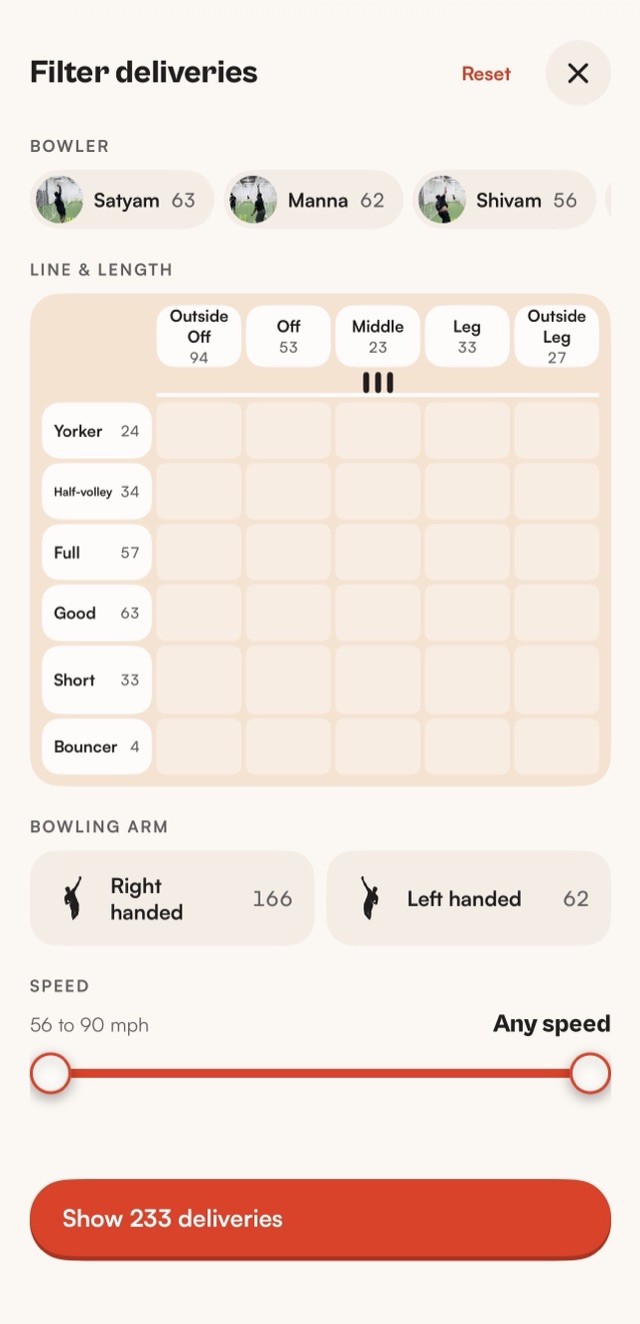
Filter a session by line and length, pick out the balls that landed on your spot, and compare how far each one turned. Then try a change, a little more flight or a sharper flick, and see whether the numbers move. Every ball has its clip, so you can watch your action next to the result.
New to measuring in the nets? Start with how to measure bowling speed on your phone.
See how far it really turned
YORKER AI is coming to the App Store for iPhone. Put your phone behind the bowler's end, line up the stumps and bowl. Every ball gets its bowling speed, line, length, swing, spin, release height, 3D trajectory and a clip, and every session is saved.
See how the bowling speed app works.
Quick answers
Is off spin or leg spin easier to learn?
Off spin is usually easier to control at first, because the fingers do the work and the wrist stays firm. Leg spin takes longer to land consistently but can turn the ball a long way. Try both in the nets and work with your coach.
Does YORKER AI work for spin bowling?
Yes. YORKER AI measures spin as well as swing, so spinners get more than a bowling speed: line and length, where the ball bounced and release height too. Replay its 3D trajectory to see how far it turned.
How do I spin the ball more?
Check your grip has the seam under the spinning finger, relax your hand, and give the ball a sharper flick as you let go. Use your body too: a full action and follow-through put more on the ball than the fingers alone.
Can I see only my own balls if several spinners share the net?
YORKER AI groups the balls by who bowled them, from the way each player runs in. Tag each group with a name once, then filter by bowler.